
If your index finger aches after a day of clicking, or a finger catches in a bent position and then suddenly snaps straight, you may be dealing with trigger finger, often called "mouse finger". It is common, it is treatable, and changing how you use your mouse is one of the most effective things you can do to help it settle.
This article is general educational information written by the KOS clinical team. It is not a diagnosis or a substitute for advice from your GP, consultant or physiotherapist. If your symptoms are severe, worsening, or include any of the warning signs listed below, seek medical care first.
What is trigger finger?
Trigger finger, medically known as stenosing tenosynovitis, affects the tendons that bend your fingers and thumb. Each of these flexor tendons runs through a tunnel called the tendon sheath, held close to the bone by a series of fibrous bands called pulleys.
The first of these bands, the A1 pulley, sits in the palm at the base of the finger. When the tendon or the pulley becomes irritated and thickened, the tendon can no longer glide smoothly underneath it. Sometimes a small lump, or nodule, forms on the tendon. As you bend the finger, the nodule squeezes under the pulley and catches. When you straighten it, the finger stays bent and then releases with a click or snap, like pulling and releasing a trigger.
The ring finger and thumb are affected most often, followed by the middle and index fingers. In heavy mouse users, the index finger is a frequent complaint because it does almost all the clicking.
| At a glance | |
|---|---|
| Typical symptoms | Stiffness, especially first thing in the morning; a clicking or popping feeling when moving the finger; a tender lump at the base of the finger on the palm side; the finger catching or locking bent and snapping straight |
| How common | Estimates usually put the lifetime risk at around 2 to 3% of adults, with considerably higher rates in people with diabetes |
| Who is most at risk | Adults aged roughly 40 to 60, women more than men, and people with diabetes, rheumatoid arthritis or hypothyroidism |
| Activity link | Repeated forceful gripping and sustained pressure at the base of the fingers; prolonged clicking and scrolling can aggravate it |
| Usual treatments | Reducing aggravating activity, a finger splint, gentle exercises, steroid injection, and a minor procedure to release the pulley if it persists |
How symptoms tend to progress
| Stage | What you notice |
|---|---|
| Early | Pain or tenderness at the base of the finger, without catching |
| Catching | A click or catch when bending and straightening, which you can overcome yourself |
| Locking | The finger locks bent and you need your other hand to straighten it |
| Fixed | The finger cannot be fully straightened or fully bent |
The earlier trigger finger is addressed, the more likely simple measures are to work. Locking or fixed fingers should be assessed by your GP.
Warning signs that need medical attention first
See your GP promptly if you notice:
- A finger that is locked and cannot be straightened, even with your other hand
- Symptoms that are getting worse or have not improved after a few weeks
- Several fingers affected, or symptoms alongside joint swelling elsewhere
- Numbness or tingling in the fingers, which suggests a nerve problem such as carpal tunnel syndrome
Go to an emergency department or call 112 / 999 immediately if you have:
- A finger that is red, hot, swollen and very painful to straighten, particularly after a cut, bite or puncture wound, or with fever. This can indicate an infection of the tendon sheath and needs emergency treatment
What causes trigger finger?
Repetitive gripping and mouse use
Activities that involve repeated or sustained gripping put pressure on the A1 pulley. With a conventional mouse, the index finger hovers, clicks and scrolls thousands of times a day, often while the hand grips the sides of the mouse. Gripping tighter than necessary, a mouse that is too small, and a stiff scroll wheel all increase the load at the base of the finger.
Underlying health conditions
Diabetes is one of the strongest risk factors. Raised blood glucose is thought to cause changes in collagen within tendons and their sheaths, making them thicker and stiffer. Rheumatoid arthritis and hypothyroidism are also linked. If you have trigger finger and any of these conditions, mention it to your GP, as managing the underlying condition matters.
Age and sex
Trigger finger is most common between the ages of 40 and 60 and affects women more often than men. Hormonal factors and lifetime hand use are thought to play a part.
How your desk setup affects trigger finger
| What we often see | Why it aggravates trigger finger | What helps |
|---|---|---|
| Tight grip on a small mouse | Sustained pressure across the base of the fingers | A mouse sized to your hand, used with a relaxed grip |
| Index finger doing every click | Thousands of repetitions concentrated on one tendon | Reassign clicks to another finger, the other hand or a central device |
| Stiff or notched scroll wheel | Repeated forceful flexion of the same finger | Smooth scroll, or scrolling with a control pad |
| Clicking and dragging for long periods | Sustained flexion under load | Keyboard shortcuts and software settings such as click lock |
| Resting the palm hard on the mouse | Direct pressure over the A1 pulley | Device that supports the hand without pressing on the palm |
Quick changes you can make today
- Loosen your grip. You only need enough contact to guide the mouse. Check your hand several times a day.
- Swap the clicking finger. Use your operating system's mouse settings to swap primary and secondary buttons, or reprogram buttons so a different finger takes the main click.
- Cut the clicks. Learn shortcuts for copy, paste, undo, tab switching and closing windows. Use dictation for long documents.
- Turn on click lock. On Windows, ClickLock lets you drag without holding the button down.
- Share between hands. A central pointing device can be used with either hand, letting the painful side rest.
- Take micro-breaks. Every 20 to 30 minutes, let go of the mouse and gently open and spread your fingers.
Ergonomic mice our physiotherapists often consider for trigger finger
The aim is to take load off the affected finger: fewer forceful clicks, less gripping, and less pressure across the palm. These are the devices we most often trial.
Products to discuss at your consultation
Sits centrally in front of the keyboard. Instead of a hard scroll wheel and one clicking finger, you move the cursor with a smooth control bar using several fingers, and clicks can be assigned to buttons for either hand. This spreads the workload and lets an inflamed finger rest completely.
A slimmer, wireless MouseTrapper with eight programmable keys, useful for moving frequent actions such as double-click or copy and paste away from the painful finger.
Holds the hand in a relaxed handshake position so you don't need to grip, with light-action buttons. Because the buttons can be reprogrammed, you can move the main click from the index finger to the middle finger or thumb. Also available in a left-handed version if you want to switch hands.
Available in small, regular and large, so the mouse fits your hand and you aren't squeezing a device that is too small. A built-in break reminder prompts regular pauses.
Browse our full MouseTrapper range, vertical mice and RSI and hand pain products.
Why the right product for trigger finger is found in a consultation, not a basket
Every product above can help the right person, and none of them helps everyone. Trigger finger rarely presents the same way twice: the side, the aggravating posture, your body size, the desk you actually work at and what your physio or consultant has told you all change the answer. The finger affected, your hand size and the work you do all decide whether a vertical mouse, a central pointing device or simply reprogrammed buttons will help most. That is why the most reliable way to choose is to sit down with one of our physiotherapists or clinical ergonomists, recreate how you work, and test options side by side before you spend anything.
Gentle exercises for trigger finger
Gentle movement helps keep the tendon gliding and reduces stiffness, especially in the morning. These exercises are not a cure, and they will not release a finger that is locked, but done regularly and gently alongside workstation changes they can make a noticeable difference to comfort.
Before you start
- Move slowly and stay in a pain-free or mildly uncomfortable range. Never force a finger that is catching or locked.
- Do not repeatedly trigger the finger on purpose. Each snap through the pulley can irritate it further.
- Warming the hand first, for example in warm water for a few minutes, often makes the exercises easier.
- If an exercise increases your pain or causes more locking, stop it and ask your physiotherapist or GP for advice.
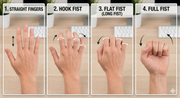
1. Tendon glides
Tendon glides move the flexor tendons through their full range so they slide smoothly through the sheath and under the A1 pulley. This is usually the most useful of the three for stiffness and mild catching.
- Sit with your forearm resting on the desk and your hand upright, fingers straight and together, as if signalling "stop".
- Hook fist (shown): keeping the knuckles at the base of your fingers straight, bend the middle and end joints so your fingertips curl down towards the top of your palm. Hold for 5 seconds, then straighten.
- Full fist: curl all the joints so your fingertips touch the middle of your palm, keeping the grip gentle. Hold, then straighten.
- Tabletop: bend only at the base knuckles, keeping the fingers straight, so your hand looks like a table. Hold, then straighten.
- Straight fist: bend at the base and middle joints with the fingertips straight, so they touch the base of the palm. Hold, then straighten.
- How much
- Each position for 5 seconds, 5 to 10 rounds, two or three times a day
- Should feel
- A gentle stretch or pull along the fingers and palm
- Stop if
- The finger catches painfully, locks, or pain increases afterwards. Leave out any position that triggers the finger
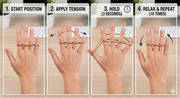
2. Finger spreads with a band
This works the small muscles that open and spread the fingers, the opposite of the gripping action that loads the tendon all day. It also gives the hand a deliberate break from the curled mousing position.
- Place a light rubber band around all your fingers and thumb, just below the top knuckles.
- Rest your forearm and hand on the desk with the fingers slightly bent.
- Slowly spread your fingers and thumb apart against the band as far as is comfortable.
- Hold for 3 seconds, then slowly let the fingers come back together.
- How much
- 10 repetitions, two or three times a day. Start without a band if your hand is sore, and only use a light band
- Should feel
- Mild effort across the back of the hand and between the fingers
- Stop if
- You feel pain at the base of the finger, or the band presses on a sore area
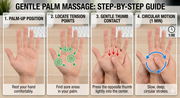
3. Gentle palm massage
Light massage over the tender area at the base of the finger can ease tension in the surrounding tissues and help the hand feel less stiff before or after exercise.
- Rest the affected hand palm up on the desk or your lap.
- Find the tender spot or small lump in your palm at the base of the affected finger.
- Using the pad of the opposite thumb, make slow, small circles over and around the area with light to moderate pressure.
- Then stroke gently along the line of the finger towards the wrist.
- How much
- About 1 minute, a few times a day, or before the tendon glides
- Should feel
- Soothing, with no more than mild tenderness
- Stop if
- It is sharply painful, or the area is red, hot or swollen. Never press hard on the lump
Medical treatment options
If symptoms persist despite activity changes and exercises, your GP or a hand specialist may suggest:
- Splinting: a small splint that holds the affected finger straight, often worn at night, to rest the tendon.
- Steroid injection: an injection into the tendon sheath that reduces swelling and is effective for many people, sometimes needing a repeat.
- Release procedure: a minor operation, usually under local anaesthetic, that releases the A1 pulley so the tendon can glide freely.
Whatever treatment you have, reducing the load on the finger at work helps prevent it coming back.
For employers and H&S managers
If an employee reports finger, hand or wrist pain, Regulation 72 treats that as a reason to review their workstation. A generic DSE checklist is rarely enough once symptoms are present. A detailed ergonomic assessment with one of our physiotherapists or clinical ergonomists gives you specific, defensible recommendations, and for complex or long-standing cases a workplace needs assessment looks at the whole role. Equipment is then matched to the person, not bought on guesswork.
Related reading
- Best keyboard and mouse for carpal tunnel syndrome
- De Quervain's tenosynovitis: best mouse and desk setup
- Best mouse for tennis elbow
- RSI prevention: five tips for computer and mouse users
- Preventing workplace pain: 10 tips to stay mobile
Book your showroom consultation
Avoid buying the wrong equipment. Visit our Dublin or Tipperary showrooms for a free personal consultation with our clinical experts, or connect with us online for a bespoke virtual tour.
Dublin Showroom
3 Clare Street, Dublin 2, D02 KC82
Schedule a complimentary visit to our city studio. Test-drive our full range of specialist ergonomic mice, keyboards, clinical seating and sit-stand desks with expert guidance.
Book DublinTipperary Showroom
Tobin's Cross, Holycross, E41 TP04
Our main clinical centre. Book your free in-depth posture consultation and browse Ireland's most extensive range of ergonomic furniture and accessories.
Book TipperaryOnline Consultation
Available anywhere in Ireland
Our expertise, delivered anywhere. A high-definition virtual consultation and guided product demonstration with our clinical team, from your own desk.
Book onlineVisits are by appointment only, so you get our full attention. Questions first? Contact our team.
Frequently asked questions
What is the best mouse for trigger finger?
Devices that reduce gripping and take clicks away from the affected finger help most. Many people do well with a central pointing device such as the MouseTrapper Advance 2.0, or a vertical mouse with reprogrammable buttons such as the Evoluent 4. Trying them in a consultation is the best way to find what suits your hand.
Can using a computer mouse cause trigger finger?
Mouse use alone is rarely the only cause, but repeated clicking, scrolling and gripping place load on the tendon and pulley at the base of the finger and can aggravate trigger finger or keep it from settling.
Do exercises cure trigger finger?
Gentle exercises such as tendon glides can reduce stiffness and help the tendon move more smoothly, but they do not cure it on their own. They work best alongside reducing the aggravating activity, and sometimes splinting or medical treatment.
Should I force my finger straight when it locks?
No. Avoid forcing or repeatedly triggering the finger, as this can irritate the tendon further. A finger that locks regularly or cannot be straightened should be assessed by your GP.
How long does trigger finger take to go away?
Mild cases can settle over weeks to a few months with rest from aggravating activity and splinting. Persistent cases often respond well to a steroid injection or a minor release procedure.
Is trigger finger more common with diabetes?
Yes. People with diabetes have a considerably higher risk of trigger finger and are more likely to have more than one finger affected. Mention any trigger finger symptoms to your GP if you have diabetes.
Can I try ergonomic mice before buying?
Yes. You can test our full range of mice and central pointing devices with a physiotherapist at our Dublin or Tipperary showrooms, or in an online consultation.
If your index finger aches after a day of clicking, or a finger catches in a bent position and then suddenly snaps straight, you may be dealing with trigger finger, often called "mouse finger". It is common, it is treatable, and changing how you use your mouse is one of the most effective things you can do to help it settle.
This article is general educational information written by the KOS clinical team. It is not a diagnosis or a substitute for advice from your GP, consultant or physiotherapist. If your symptoms are severe, worsening, or include any of the warning signs listed below, seek medical care first.
What is trigger finger?
Trigger finger, medically known as stenosing tenosynovitis, affects the tendons that bend your fingers and thumb. Each of these flexor tendons runs through a tunnel called the tendon sheath, held close to the bone by a series of fibrous bands called pulleys.
The first of these bands, the A1 pulley, sits in the palm at the base of the finger. When the tendon or the pulley becomes irritated and thickened, the tendon can no longer glide smoothly underneath it. Sometimes a small lump, or nodule, forms on the tendon. As you bend the finger, the nodule squeezes under the pulley and catches. When you straighten it, the finger stays bent and then releases with a click or snap, like pulling and releasing a trigger.
The ring finger and thumb are affected most often, followed by the middle and index fingers. In heavy mouse users, the index finger is a frequent complaint because it does almost all the clicking.
| At a glance | |
|---|---|
| Typical symptoms | Stiffness, especially first thing in the morning; a clicking or popping feeling when moving the finger; a tender lump at the base of the finger on the palm side; the finger catching or locking bent and snapping straight |
| How common | Estimates usually put the lifetime risk at around 2 to 3% of adults, with considerably higher rates in people with diabetes |
| Who is most at risk | Adults aged roughly 40 to 60, women more than men, and people with diabetes, rheumatoid arthritis or hypothyroidism |
| Activity link | Repeated forceful gripping and sustained pressure at the base of the fingers; prolonged clicking and scrolling can aggravate it |
| Usual treatments | Reducing aggravating activity, a finger splint, gentle exercises, steroid injection, and a minor procedure to release the pulley if it persists |
How symptoms tend to progress
| Stage | What you notice |
|---|---|
| Early | Pain or tenderness at the base of the finger, without catching |
| Catching | A click or catch when bending and straightening, which you can overcome yourself |
| Locking | The finger locks bent and you need your other hand to straighten it |
| Fixed | The finger cannot be fully straightened or fully bent |
The earlier trigger finger is addressed, the more likely simple measures are to work. Locking or fixed fingers should be assessed by your GP.
Warning signs that need medical attention first
See your GP promptly if you notice:
- A finger that is locked and cannot be straightened, even with your other hand
- Symptoms that are getting worse or have not improved after a few weeks
- Several fingers affected, or symptoms alongside joint swelling elsewhere
- Numbness or tingling in the fingers, which suggests a nerve problem such as carpal tunnel syndrome
Go to an emergency department or call 112 / 999 immediately if you have:
- A finger that is red, hot, swollen and very painful to straighten, particularly after a cut, bite or puncture wound, or with fever. This can indicate an infection of the tendon sheath and needs emergency treatment
What causes trigger finger?
Repetitive gripping and mouse use
Activities that involve repeated or sustained gripping put pressure on the A1 pulley. With a conventional mouse, the index finger hovers, clicks and scrolls thousands of times a day, often while the hand grips the sides of the mouse. Gripping tighter than necessary, a mouse that is too small, and a stiff scroll wheel all increase the load at the base of the finger.
Underlying health conditions
Diabetes is one of the strongest risk factors. Raised blood glucose is thought to cause changes in collagen within tendons and their sheaths, making them thicker and stiffer. Rheumatoid arthritis and hypothyroidism are also linked. If you have trigger finger and any of these conditions, mention it to your GP, as managing the underlying condition matters.
Age and sex
Trigger finger is most common between the ages of 40 and 60 and affects women more often than men. Hormonal factors and lifetime hand use are thought to play a part.
How your desk setup affects trigger finger
| What we often see | Why it aggravates trigger finger | What helps |
|---|---|---|
| Tight grip on a small mouse | Sustained pressure across the base of the fingers | A mouse sized to your hand, used with a relaxed grip |
| Index finger doing every click | Thousands of repetitions concentrated on one tendon | Reassign clicks to another finger, the other hand or a central device |
| Stiff or notched scroll wheel | Repeated forceful flexion of the same finger | Smooth scroll, or scrolling with a control pad |
| Clicking and dragging for long periods | Sustained flexion under load | Keyboard shortcuts and software settings such as click lock |
| Resting the palm hard on the mouse | Direct pressure over the A1 pulley | Device that supports the hand without pressing on the palm |
Quick changes you can make today
- Loosen your grip. You only need enough contact to guide the mouse. Check your hand several times a day.
- Swap the clicking finger. Use your operating system's mouse settings to swap primary and secondary buttons, or reprogram buttons so a different finger takes the main click.
- Cut the clicks. Learn shortcuts for copy, paste, undo, tab switching and closing windows. Use dictation for long documents.
- Turn on click lock. On Windows, ClickLock lets you drag without holding the button down.
- Share between hands. A central pointing device can be used with either hand, letting the painful side rest.
- Take micro-breaks. Every 20 to 30 minutes, let go of the mouse and gently open and spread your fingers.
Ergonomic mice our physiotherapists often consider for trigger finger
The aim is to take load off the affected finger: fewer forceful clicks, less gripping, and less pressure across the palm. These are the devices we most often trial.
Products to discuss at your consultation
Sits centrally in front of the keyboard. Instead of a hard scroll wheel and one clicking finger, you move the cursor with a smooth control bar using several fingers, and clicks can be assigned to buttons for either hand. This spreads the workload and lets an inflamed finger rest completely.
A slimmer, wireless MouseTrapper with eight programmable keys, useful for moving frequent actions such as double-click or copy and paste away from the painful finger.
Holds the hand in a relaxed handshake position so you don't need to grip, with light-action buttons. Because the buttons can be reprogrammed, you can move the main click from the index finger to the middle finger or thumb. Also available in a left-handed version if you want to switch hands.
Available in small, regular and large, so the mouse fits your hand and you aren't squeezing a device that is too small. A built-in break reminder prompts regular pauses.
Browse our full MouseTrapper range, vertical mice and RSI and hand pain products.
Why the right product for trigger finger is found in a consultation, not a basket
Every product above can help the right person, and none of them helps everyone. Trigger finger rarely presents the same way twice: the side, the aggravating posture, your body size, the desk you actually work at and what your physio or consultant has told you all change the answer. The finger affected, your hand size and the work you do all decide whether a vertical mouse, a central pointing device or simply reprogrammed buttons will help most. That is why the most reliable way to choose is to sit down with one of our physiotherapists or clinical ergonomists, recreate how you work, and test options side by side before you spend anything.
Gentle exercises for trigger finger
Gentle movement helps keep the tendon gliding and reduces stiffness, especially in the morning. These exercises are not a cure, and they will not release a finger that is locked, but done regularly and gently alongside workstation changes they can make a noticeable difference to comfort.
Before you start
- Move slowly and stay in a pain-free or mildly uncomfortable range. Never force a finger that is catching or locked.
- Do not repeatedly trigger the finger on purpose. Each snap through the pulley can irritate it further.
- Warming the hand first, for example in warm water for a few minutes, often makes the exercises easier.
- If an exercise increases your pain or causes more locking, stop it and ask your physiotherapist or GP for advice.
1. Tendon glides
Tendon glides move the flexor tendons through their full range so they slide smoothly through the sheath and under the A1 pulley. This is usually the most useful of the three for stiffness and mild catching.
- Sit with your forearm resting on the desk and your hand upright, fingers straight and together, as if signalling "stop".
- Hook fist (shown): keeping the knuckles at the base of your fingers straight, bend the middle and end joints so your fingertips curl down towards the top of your palm. Hold for 5 seconds, then straighten.
- Full fist: curl all the joints so your fingertips touch the middle of your palm, keeping the grip gentle. Hold, then straighten.
- Tabletop: bend only at the base knuckles, keeping the fingers straight, so your hand looks like a table. Hold, then straighten.
- Straight fist: bend at the base and middle joints with the fingertips straight, so they touch the base of the palm. Hold, then straighten.
- How much
- Each position for 5 seconds, 5 to 10 rounds, two or three times a day
- Should feel
- A gentle stretch or pull along the fingers and palm
- Stop if
- The finger catches painfully, locks, or pain increases afterwards. Leave out any position that triggers the finger
2. Finger spreads with a band
This works the small muscles that open and spread the fingers, the opposite of the gripping action that loads the tendon all day. It also gives the hand a deliberate break from the curled mousing position.
- Place a light rubber band around all your fingers and thumb, just below the top knuckles.
- Rest your forearm and hand on the desk with the fingers slightly bent.
- Slowly spread your fingers and thumb apart against the band as far as is comfortable.
- Hold for 3 seconds, then slowly let the fingers come back together.
- How much
- 10 repetitions, two or three times a day. Start without a band if your hand is sore, and only use a light band
- Should feel
- Mild effort across the back of the hand and between the fingers
- Stop if
- You feel pain at the base of the finger, or the band presses on a sore area
3. Gentle palm massage
Light massage over the tender area at the base of the finger can ease tension in the surrounding tissues and help the hand feel less stiff before or after exercise.
- Rest the affected hand palm up on the desk or your lap.
- Find the tender spot or small lump in your palm at the base of the affected finger.
- Using the pad of the opposite thumb, make slow, small circles over and around the area with light to moderate pressure.
- Then stroke gently along the line of the finger towards the wrist.
- How much
- About 1 minute, a few times a day, or before the tendon glides
- Should feel
- Soothing, with no more than mild tenderness
- Stop if
- It is sharply painful, or the area is red, hot or swollen. Never press hard on the lump
Medical treatment options
If symptoms persist despite activity changes and exercises, your GP or a hand specialist may suggest:
- Splinting: a small splint that holds the affected finger straight, often worn at night, to rest the tendon.
- Steroid injection: an injection into the tendon sheath that reduces swelling and is effective for many people, sometimes needing a repeat.
- Release procedure: a minor operation, usually under local anaesthetic, that releases the A1 pulley so the tendon can glide freely.
Whatever treatment you have, reducing the load on the finger at work helps prevent it coming back.
For employers and H&S managers
If an employee reports finger, hand or wrist pain, Regulation 72 treats that as a reason to review their workstation. A generic DSE checklist is rarely enough once symptoms are present. A detailed ergonomic assessment with one of our physiotherapists or clinical ergonomists gives you specific, defensible recommendations, and for complex or long-standing cases a workplace needs assessment looks at the whole role. Equipment is then matched to the person, not bought on guesswork.
Related reading
- Best keyboard and mouse for carpal tunnel syndrome
- De Quervain's tenosynovitis: best mouse and desk setup
- Best mouse for tennis elbow
- RSI prevention: five tips for computer and mouse users
- Preventing workplace pain: 10 tips to stay mobile
Book your showroom consultation
Avoid buying the wrong equipment. Visit our Dublin or Tipperary showrooms for a free personal consultation with our clinical experts, or connect with us online for a bespoke virtual tour.
Dublin Showroom
3 Clare Street, Dublin 2, D02 KC82
Schedule a complimentary visit to our city studio. Test-drive our full range of specialist ergonomic mice, keyboards, clinical seating and sit-stand desks with expert guidance.
Book DublinTipperary Showroom
Tobin's Cross, Holycross, E41 TP04
Our main clinical centre. Book your free in-depth posture consultation and browse Ireland's most extensive range of ergonomic furniture and accessories.
Book TipperaryOnline Consultation
Available anywhere in Ireland
Our expertise, delivered anywhere. A high-definition virtual consultation and guided product demonstration with our clinical team, from your own desk.
Book onlineVisits are by appointment only, so you get our full attention. Questions first? Contact our team.
Frequently asked questions
What is the best mouse for trigger finger?
Devices that reduce gripping and take clicks away from the affected finger help most. Many people do well with a central pointing device such as the MouseTrapper Advance 2.0, or a vertical mouse with reprogrammable buttons such as the Evoluent 4. Trying them in a consultation is the best way to find what suits your hand.
Can using a computer mouse cause trigger finger?
Mouse use alone is rarely the only cause, but repeated clicking, scrolling and gripping place load on the tendon and pulley at the base of the finger and can aggravate trigger finger or keep it from settling.
Do exercises cure trigger finger?
Gentle exercises such as tendon glides can reduce stiffness and help the tendon move more smoothly, but they do not cure it on their own. They work best alongside reducing the aggravating activity, and sometimes splinting or medical treatment.
Should I force my finger straight when it locks?
No. Avoid forcing or repeatedly triggering the finger, as this can irritate the tendon further. A finger that locks regularly or cannot be straightened should be assessed by your GP.
How long does trigger finger take to go away?
Mild cases can settle over weeks to a few months with rest from aggravating activity and splinting. Persistent cases often respond well to a steroid injection or a minor release procedure.
Is trigger finger more common with diabetes?
Yes. People with diabetes have a considerably higher risk of trigger finger and are more likely to have more than one finger affected. Mention any trigger finger symptoms to your GP if you have diabetes.
Can I try ergonomic mice before buying?
Yes. You can test our full range of mice and central pointing devices with a physiotherapist at our Dublin or Tipperary showrooms, or in an online consultation.

 and then Add to Home Screen.