

Have you ever been working at your desk for a few hours and felt a sharp ache in your index finger from clicking your mouse? Or worse, have you experienced a sudden, painful catch or "lock" in your finger as you tried to straighten it?
If so, you might be dealing with a frustrating and increasingly common condition known as Trigger Finger (also referred to as "mouse finger").
This repetitive strain injury affects the tendons in your hand, causing discomfort, stiffness, and limiting your ability to perform everyday tasks comfortably.
In this comprehensive guide, we will dive deep into what trigger finger is, what causes it, light exercises that can provide relief, and the best ergonomic mice from KOS.ie to help you work pain-free.
Did You Know? Trigger finger is one of the most common causes of hand pain in adults. According to PubMed, around 2% of the general adult population is affected by Trigger Finger, but that number is rising as our screen time increases.
What Exactly is Trigger Finger?
Trigger finger, medically known as stenosing tenosynovitis, is a condition that affects the movement of your fingers or thumb. It is characterised by your finger getting temporarily stuck in a bent position, before suddenly snapping or popping straight, much like pulling and releasing the trigger of a gun.
To understand why this happens, we have to look at the anatomy of the hand:
Tendons are tough cords of tissue that connect muscle to bone.
In your hand, these tendons glide through a protective tunnel known as the tendon sheath.
When a tendon or its sheath becomes irritated and inflamed, swelling occurs, sometimes forming a small lump (nodule).
This swelling makes it difficult for the tendon to glide smoothly through the sheath. When it gets caught, the finger locks.
It was in 1850 when French physician Alphonse Notta first documented this disconcerting condition, but today, modern technology and repetitive desk work have made it more prevalent than ever.
3 Main Causes of Trigger Finger
The incidence of trigger finger globally is far higher than most realize. The lifetime risk incidence is 2% to 3%, but it can skyrocket to up to 10% for individuals with certain health conditions.
Here are the three primary causes:
1. Repetitive Gripping and Mouse Usage
Indiscriminate and prolonged use of a standard computer mouse is a massive contributor. The repetitive micro-movements of your index finger constantly hovering, clicking, and scrolling can lead to severe inflammation of the tendon sheath. Using an improper mouse forces your hand into an unnatural, tense grip for 8+ hours a day, paving the way for "mouse finger pain."
2. Underlying Health Conditions
People suffering from conditions like Rheumatoid Arthritis or Diabetes are at a significantly higher risk. While the exact medical mechanics are still being studied, it is believed that high blood glucose levels in diabetics create cross-links between collagen molecules. This results in excess collagen build-up in the tendon sheaths, restricting movement.
3. Age and Gender
Studies show that women are more prone to developing trigger finger than men. Furthermore, adults between the ages of 40 and 60 are the most likely demographic to experience it. Medical experts suggest that hormonal changes, combined with a lifetime of repetitive tasks, play a large role in the higher prevalence among women.
Symptoms to Watch Out For
If you are worried about your hand health, look out for these early warning signs:
Stiffness in the finger or thumb, especially in the morning.
A popping or clicking sensation as you move your finger.
Tenderness or a small bump (nodule) at the base of the affected finger on the palm side.
Your finger locking or catching in a bent position, which suddenly pops straight.
Complete locking of the finger where you cannot physically straighten it without using your other hand.
The Best Ergonomic Mice for Trigger Finger (Available at KOS)
The best way to combat trigger finger is to remove the root cause: the repetitive strain of a standard mouse. An ergonomic mouse minimizes tendon irritation, eliminates heavy clicking, and supports your hand in a neutral posture.
Here are the top-recommended ergonomic mice available on www.kos.ie to combat trigger finger:
1. The MouseTrapper Advance 2.0
Traditional mice require thousands of localized taps and repetitive scrolling from one finger. The MouseTrapper Advance 2.0 completely eliminates this.
Why it works: It acts as a centered pointing device, placing your hands centrally in front of your keyboard. Instead of a hard plastic scroll wheel, you navigate using a super-smooth steering pad with multiple fingers.
The Benefit: Scrolling and clicking can be customized to buttons, distributing the workload across both hands and completely resting the inflamed trigger finger.
2. The Evoluent 4 Wireless Vertical Mouse
The standard "palm-down" posture of regular mice twists your forearm and forces your fingers to fight gravity when clicking. The Evoluent 4 Wireless Vertical Mouse places your hand in a natural, relaxed "handshake" position.
Why it works: It requires zero lifting or hovering. The weight of your hand is supported in an anatomically comfortable position.
The Benefit: The buttons require an incredibly light touch. Furthermore, the Evoluent features strategically placed, reprogrammable buttons. If your index finger is suffering from trigger finger, you can simply program the mouse to "left-click" using your thumb or middle finger instead!
Light Exercises for Trigger Finger Relief
While modifying your workstation is critical, doing gentle stretches can help maintain mobility and reduce stiffness.
Medical Disclaimer: The following exercises are for informational purposes only and should not replace professional medical advice. If you are experiencing severe pain, swelling, or your finger is permanently locked, consult a healthcare professional immediately.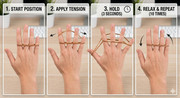
1. Finger Spread
Wrap a standard rubber band around your fingers and thumb. Gently push your fingers outward against the resistance of the band. Hold for 3 seconds, then relax.
Repeat 10 times to strengthen the extensor muscles.
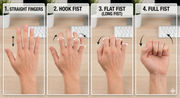
2. Tendon Glides
Start with your hand open, fingers straight up. Bend your fingers down so the tips touch the top of your palm (making a "hook" fist). Hold for 5 seconds, then slowly straighten.
Repeat 5-10 times to help the tendons glide through their sheaths.
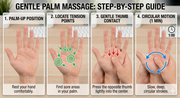
3. Gentle Palm Massage
Using your opposite thumb, gently massage the base of the affected finger on your palm. Use slow, circular motions over the area.
Perform for 1 minute to help relieve tension and promote blood flow to the inflamed nodule.
Light Exercises for Trigger Finger Relief
While modifying your workstation is critical, doing gentle stretches can help maintain mobility and reduce stiffness.
Medical Disclaimer: The following exercises are for informational purposes only and should not replace professional medical advice. If you are experiencing severe pain, swelling, or your finger is permanently locked, consult a healthcare professional immediately.
1. Finger Spread
Wrap a standard rubber band around your fingers and thumb. Gently push your fingers outward against the resistance of the band. Hold for 3 seconds, then relax.
Repeat 10 times to strengthen the extensor muscles.
2. Tendon Glides
Start with your hand open, fingers straight up. Bend your fingers down so the tips touch the top of your palm (making a "hook" fist). Hold for 5 seconds, then slowly straighten.
Repeat 5-10 times to help the tendons glide through their sheaths.
3. Gentle Palm Massage
Using your opposite thumb, gently massage the base of the affected finger on your palm. Use slow, circular motions over the area.
Perform for 1 minute to help relieve tension and promote blood flow to the inflamed nodule.

 and then Add to Home Screen.